"Check the SEO of this site" is a bad prompt. The agent answers with a confident list. Some of it is right. Some of it is advice from 2019. Some of it the agent never checked at all. Run it again tomorrow and the list is different.
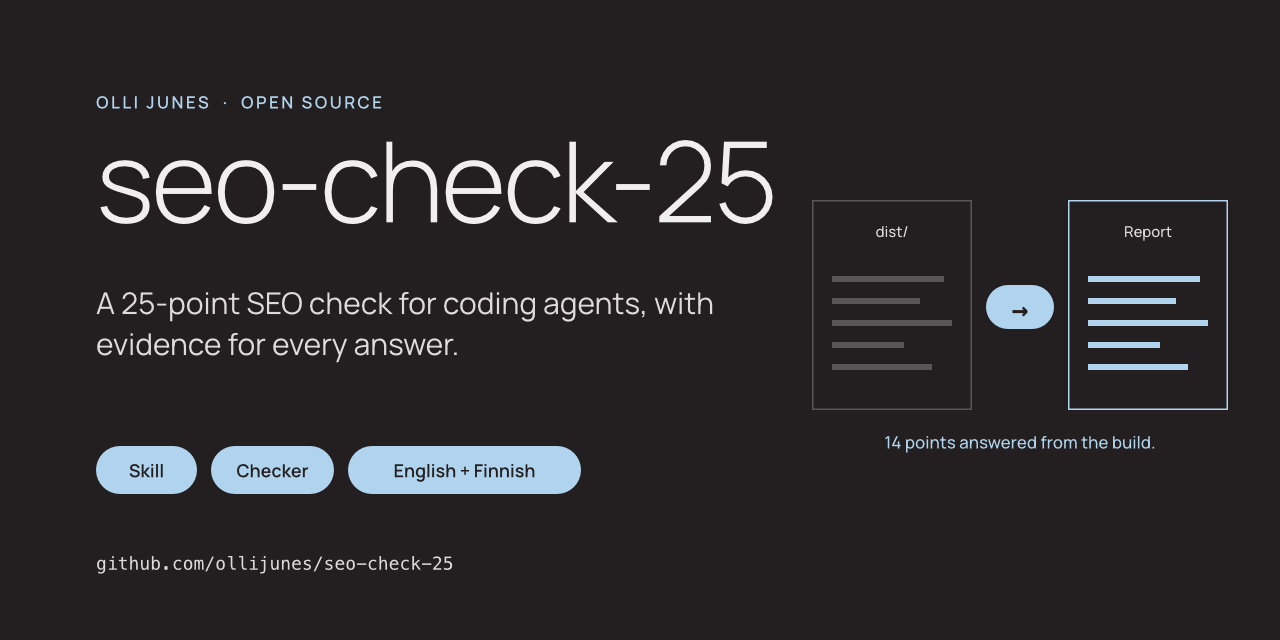
seo-check-25 is a fixed list instead: a skill the agent follows, in English and Finnish, and a small command that answers the points a machine can answer.
The problem
An SEO review without evidence is an opinion. An agent is good at sounding sure and has no reason to tell you which parts it skipped.
The second problem is damage. An agent that "fixes SEO" may edit robots.txt on a live site, change redirects or submit something in your name. A review should read. It should not act.
The list
There are 25 points. Each has a way to check it and a condition for passing. For each one the agent reports a status, the evidence and the fix. "Not checked" is an allowed answer, with a reason.
The first twenty are the base: text in the HTML without JavaScript, sitemap, robots.txt, noindex, redirect chains, broken links, canonical, meta descriptions, one h1, breadcrumbs, orphan pages, alt text, image formats, layout shifts, load time, machine-sounding text, a real author, backlinks.
The last five are about how search engines and AI features use a page today: spam policies, access for AI crawlers, snippet controls, the quality of the main content, and Bing.
Point 22 is the one people get wrong most often. Crawlers that feed AI search and crawlers that collect training data are different programs with different names. Blocking "AI bots" in one sweep also removes you from the answers people read. The skill makes the agent report each crawler in a table and leaves the training decision to you.
The skill also sets limits. The agent reads only. It sends at most two requests at a time to production. Search Console, deployments and emails to other sites stay with the owner.
The command
seo-check dist reads a built site from disk. It answers 14 of the 25 points with evidence and flags three more for a person to read. The rest it marks as not checked, because they need the live site, the owner or a reader.
It makes no network requests and changes nothing. --strict makes it fail a CI run when something needs fixing.
What I have tested
The tests build a small clean site and break one thing at a time: a missing canonical, an orphan page, a blocked crawler, a page with no text in the raw HTML. CI runs them on Linux and macOS with Python 3.11 to 3.14.
I ran the command on a real Astro build of a three-page test site. It found seven things to fix, and all seven were true.
The facts about Google in the skill carry the month they were checked. I left out every figure I could not trace to a search engine's own documentation.
What it does not do
A clean report from the command covers fourteen points, not twenty-five. It does not fetch the live site, so headers, redirects, firewalls and speed are outside it. It does not judge quality: it counts an alt attribute, not whether the text is any good.
Search engines change their rules. Check a claim against the original before you put it in front of a customer. And no check can promise rankings. This one finds things that are broken.
It does not cover hreflang, local SEO or migrations.
Try it
The code is at github.com/ollijunes/seo-check-25. Build your site, run seo-check dist --site https://your-site, and read the list. Then give the skill to your agent for the points that need a reader.
Corrections are welcome, most of all when a search engine has changed its documentation. Link the search engine's own page.