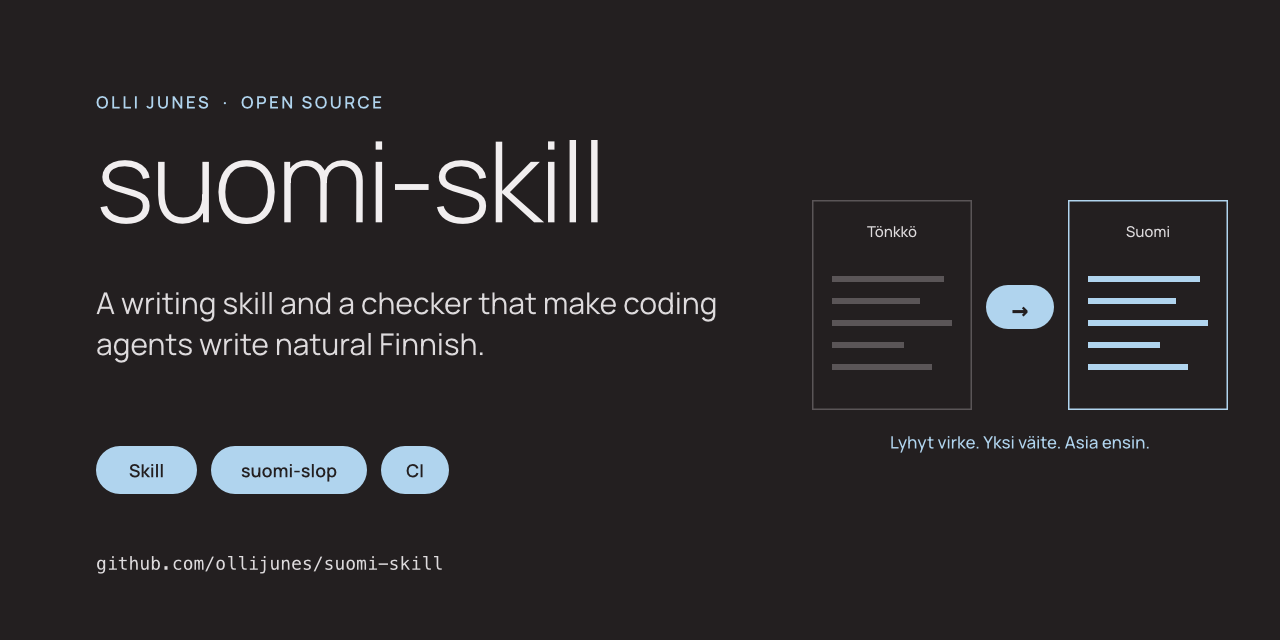
Ask a language model for Finnish and you get Finnish. The grammar holds. The cases agree. And a Finnish reader knows by the second sentence that a machine wrote it.
I let agents write and edit Finnish for my own sites, and for a long time I fixed the same things by hand. Then I wrote the fixes down as a skill the agent reads first, and a checker that finds what slipped through. Both are now in suomi-skill.
The problem
The text is English wearing Finnish words. A possessive pronoun on every noun, because English needs one. "In the long run" and "makes sense" translated word for word. A future tense Finnish does not have. Three adjectives in a row for rhythm. An exclamation mark where a Finn would put a full stop.
None of it is a grammar error, so a spell checker passes it. A reader does not. In a small language there is less machine text around, and it stands out more. Once a reader spots it, they stop trusting the page.
The skill
skills/suomi/SKILL.md is a page of instructions, written in Finnish, that the agent reads before it writes. It covers registers from chat to press release, how a Finnish sentence is built, grammar traps that models fall into, patterns that are banned outright, and a table of translated idioms with what a Finn would say instead.
The most useful part is the before-and-after table. A model follows an example better than a rule.
The last section is empty on purpose. You fill in your own names, facts and banned words. An agent that is not told a fact invents one.
The checker
suomi-slop reads Markdown, MDX, Astro, HTML and text files. It lists what it finds with a line number and one line of advice, and gives each file a score from 0 to 10.
It has sixteen rules on three levels. A generic opening such as "in this article we will look at" costs two points. Filler and translated idioms cost half a point. Patterns that are fine once and a tic when repeated cost little the first time and more after that. One real list of three things is free.
It skips code, front matter, link addresses and quotations. --min-score 8 makes it fail a CI run, so a weak text does not get published by accident.
The repository checks its own Finnish with it in CI.
What I have tested
The tests check that every rule matches its own example and that plain Finnish sentences match nothing. CI runs them on Linux and macOS with Python 3.11 to 3.14.
I ran the checker over a folder of my own Finnish notes to look for false alarms. It flagged thirteen lists of three. The ones I read were real lists, and it charged nothing for them. It took points from one document for too many dashes, which was fair.
The before-and-after pairs in the skill come from text I have had to fix. I left out every pair that pointed to a site, and rewrote a few others for the public version.
What it does not do
It is not an AI detector. People wrote these patterns long before models did. A low score says the text reads like filler. It does not say who wrote it.
It matches patterns and does not parse Finnish, so it misses forms it has no pattern for and flags some honest sentences. A score of 10 means no pattern was found. The text can still be empty.
The skill is one writer's taste in plain Finnish. Edit it to fit yours.
Try it
The code is at github.com/ollijunes/suomi-skill. Copy the skill folder to your agent's skills, fill in the last section, and run suomi-slop on a text you published last month.
Issues are welcome in Finnish or English. The most useful ones are honest sentences the checker flags, and patterns it misses.